Anger and Irritability and Frustration, Oh My!
Let's face it… we've all been angry before, and we have probably all "overreacted" to something, or someone, that has made us angry. So, let's talk about anger and its relatives, like irritability and frustration, and what to do when we or someone we love gets angry.
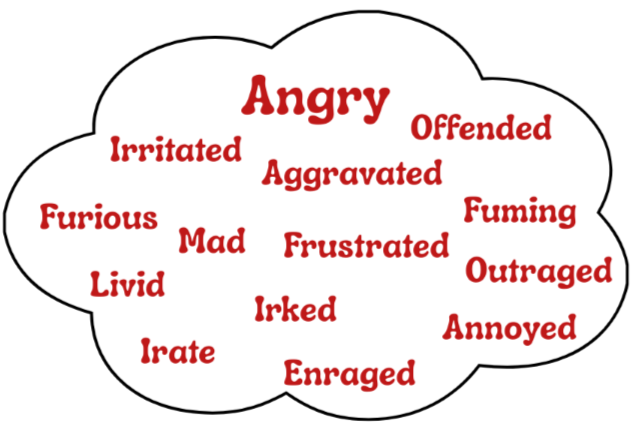
Anger and its relatives
What is anger and why do we have it?
One of the most important things to keep in mind is that anger is an emotion. Emotions are the things we feel. Emotions are NOT the things we do, which are behaviors or actions, or the things we think, which are thoughts. Emotions can influence our thoughts and behaviors. For example, when you're angry, you may roll your eyes, cross your arms, or even slam a door, which are all behaviors. You may think "I'm not going to listen to you" or "that wasn't fair." We can't see others' anger, but we can often recognize it by their actions. There are many emotions similar or related to anger, such as annoyed, frustrated, irritated/irritable, and so on. Can you think of any others?
So, why do we have anger? All of our emotions give us information, such as if a situation is dangerous, motivate us to take action, such as moving away from something dangerous, and help us communicate with others. Anger tells us that we are feeling threatened or that something unfair is happening. It helps us act in self-defense, protect ourselves and others, and take control of a situation. If you needed to fight off a bear, or stand up for a friend who is being bullied, anger could help you take action. In summary, anger is actually helpful and important in some situations.
If I'm angry, does that mean I'm right or wrong?
Emotions do not tell us if we're right or wrong. Emotions are often automatic, meaning that they happen without our control. Think about a time when you felt an emotion automatically. Maybe you felt happy when you see a loved one for the first time in a while. Maybe you felt angry when someone made a rude comment to you. Our emotions often fit or make sense in a situation. However, emotions are not facts and sometimes do not fit a situation. Sometimes, we feel scared, nervous, or anxious in situations where there is no danger. For anger, sometimes we feel angry in a situation we're not actually being threatened in, or we feel more angry than others might in that situation. The important thing to remember is that these two things can be true at the same time: I feel very angry AND my level of anger does not fit this situation.
So why does my child or teen become so angry when I ask them to do chores or turn off the screen? Why do I get so angry so quickly over seemingly small things?
We are still learning a lot about emotions. Our current understanding is that we experience emotions differently and multiple factors can play a role in these differences. We may experience different emotions in the same situation. Think about the fact that some people love rollercoasters and feel excited or exhilarated on them, while others feel terrified. Similarly, some people feel emotions more intensely than others. Think of emotion intensity like a thermometer or a scale. Some people might feel anger at a level 10 out of 10 in a situation, while others may only feel anger at a 5 out of 10 in that same situation. This can also happen for other emotions and is thought to be a normal difference between people.
A number of factors can influence how we experience our emotions. Some people are born with a genetic predisposition (higher likelihood) of experiencing intense emotions. This can explain why some people have a strong emotion, like anger, that might not seem to fit the situation – their emotions may jump into "protect" mode more easily, even when they aren't being threatened. Irritability is the tendency to feel anger more easily, or being more likely to get angry or annoyed. Sometimes, one's mood can be irritable for an extended period of time. For these folks, anger and similar emotions often appear quickly and can make it hard to control behavior, which can lead to unwanted behavior, such as yelling, hitting, or slamming doors. It may also be hard to calm down after. Irritability often increases during the pre-teen and teenage years.
Environmental and physiological factors can also make us more prone to anger. Factors such as being hungry or overly tired can make emotions more intense and harder to control. This may be your body's way of trying to protect itself from hunger and sleep deprivation! We probably all know someone who can be described as "hangry". A stressful environment can also make emotions more intense and harder to control. If we're stressed, our body and brain may already be in "protect" or "fight-or-flight" mode, which can make it easier to get really angry. Think about a time you have been really stressed. Chances are you probably got more easily annoyed or angry than when you aren't stressed.
All of these factors can make it a little harder, but not impossible, to "control" anger.
What does "controlling anger" even mean?
A common misconception is that in order to "control" anger (or any emotion), we must get rid of that emotion. This is not very accurate or helpful! Remember that emotions are often automatic, and it can be hard to force ourselves to stop feeling an emotion on command. Think about a time when someone said "stop worrying" or "stop being sad" to you. It probably did not make that emotion go away. Instead, what we want to do to "control" anger is to control our behavior and thoughts when we're angry and learn healthy ways to express anger. We want to be in control instead of anger controlling us. Controlling our thoughts and behavior can actually make our emotions change too! We’ll talk about this more in a future post.
Myths about anger
Anger is often an uncomfortable emotion. We don't like to talk about it, we don't like to feel it, and we don't like to see others angry. However, anger is a normal and common emotion, so it's important to view anger in a healthy way.
Myth: Anger is a bad emotion.
Fact: Anger is a normal and common emotion, and it actually serves an important purpose, such as protecting ourselves and others. It can be helpful to think of emotions in a neutral way, neither good or bad. Instead, it might be more helpful to think of emotions being comfortable or uncomfortable, or helpful or unhelpful in a situation.
Myth: I should never feel angry.
Fact: Everyone feels angry sometimes. Remember, anger is a normal reaction to feeling threatened or that a situation is unfair.
Myth: I should never show that I'm angry.
Fact: While we don't want to show anger in a harmful or destructive way, there are healthy ways to express anger.
Myth: If my child/teen is angry at me, I have failed as a parent.
Fact: Remember that anger is a normal emotion everyone experiences, including children and teens! Anger can be a normal reaction to not getting what you want or feeling that you were wronged, and it normally goes away! Emotions are also not facts and sometimes don't fit the situation, so your child may feel angry even if you did nothing "wrong" and that's okay!
Myth: My child/teen should never be angry at me.
Fact: Children/teens get angry at their parents sometimes, and it's not a flaw of the child/teen or the parent/caregiver. Caregivers and their children/teens sometimes disagree over things, such as screentime, curfew, or hanging out with friends. Caregivers often put rules and boundaries in place as part of their role as guardians, which is sometimes at odds with what the child/teen wants. It's normal to feel a little frustrated, annoyed, and yes, even angry, at this. Try to remember a time someone gave you a rule that you did not like; you also likely felt annoyed or frustrated, even if you understood why the rule was there.
Stay tuned and we’ll talk about how to “control” our anger in a future post! At Richmond Family Psychology, all of our providers are trained in helping young children, teens, and adults manage uncomfortable emotions like anger. Dr. Sarah Pittman in particular specializes in helping older children, teens, caregivers, and adults manage anger. Contact us today to learn more or schedule an appointment!
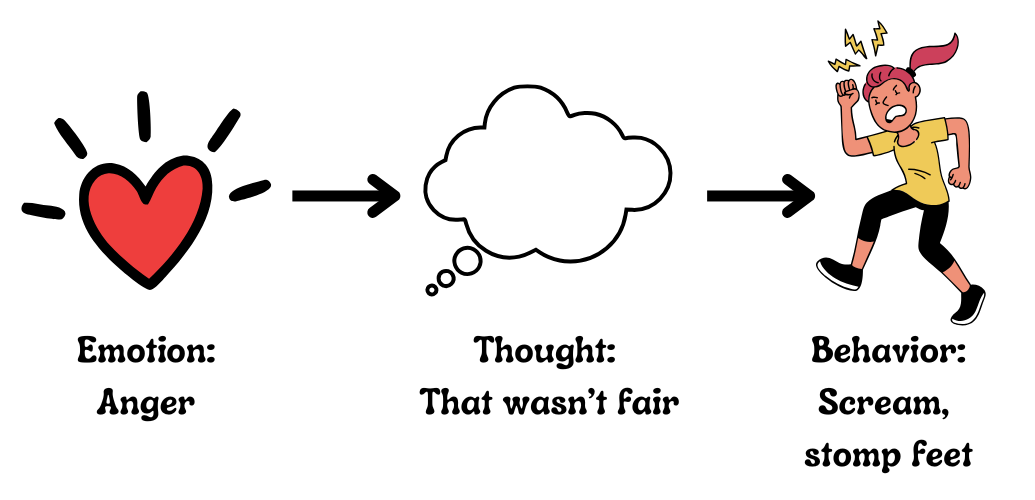
How anger can influence our thoughts and actions